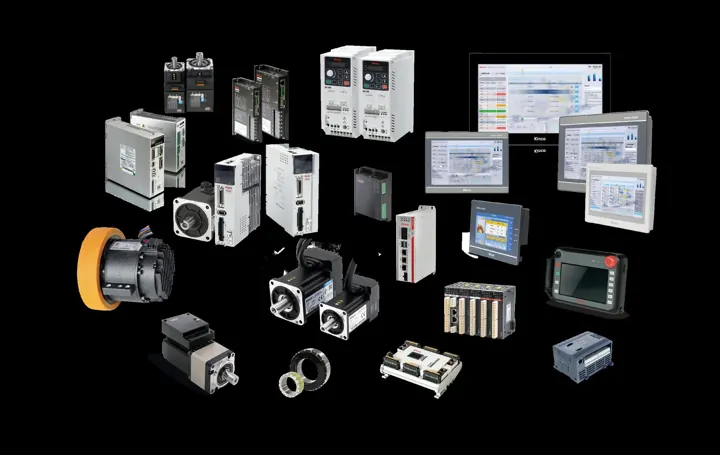
Servo Motor
- 50W–7.5 kW power range
- IP65 protection rating
- CE / UL evidence checked against the exact motor model

Application solution · ROBOT ARM
Quick answer
An industrial robotic arm needs servo motors sized by joint, compatible drives, feedback, shielded motor and encoder cables, and an operator or teach interface. The review covers Kinco 50 W–7.5 kW motors, matching FD-series drives, and standard or QT-custom teach pendants.
Industrial robot-arm OEMs evaluating configurable servo motors, teach pendants and model-specific supply terms for 6-axis, SCARA or collaborative platforms.
Reference architecture · Model-specific review
Control problem
Four scoping blocks show the review path; they are not a wiring diagram.
Size the servo axes from payload, reach, joint speed and duty cycle.
Review winding, mounting, connector and shaft requirements before selecting the robot-arm servo motor.
Choose the standard teach pendant and DTP route or the QT version when the documented OEM interface requires deeper customization.
Review aviation-grade plug connections, encoder-cable separation and teach-pendant Ethernet strain relief before integration.
Use this table to compare component roles, exact model names and key specifications before application review.
| Role | Component | Key spec |
|---|---|---|
| MOTOR | Kinco Robot Arm Servo Motor | 50W to 7.5kW · customization option · exact winding, mounting, shaft and connector scope confirmed at RFQ |
| PENDANT | Kinco Teach Pendant (standard) | Dual-core 1GHz · 256MB RAM + 4GB storage · membrane keypad · e-stop |
| PENDANT | Kinco Teach Pendant (QT option) | QT-version SDK candidate · branding and function scope confirmed at RFQ |
| SOFTWARE | Kinco DTP | Standard configuration software · electronic signature feature |
| DRIVE | Candidate Kinco FD-series servo drive | Exact pairing depends on the named motor, feedback and arm-controller architecture |
Configuration summary. This robot-arm platform covers 50 W–7.5 kW IP65 servo motors and a 4,500+ hour continuous operating test at maximum mechanical speed and 60 K temperature rise. It also includes a teach-pendant option with DTP software. Test conditions do not establish field life.
This is a candidate architecture, not a quotation. an engineering BOM review checks each line against your machine, and PLC and HMI programming scopes the control work once the hardware is agreed.
The stated test ran for 4,500+ hours at maximum mechanical speed and 60 K temperature rise. It does not establish field life; real results depend on duty, ambient conditions and integration.
No named robotics platforms are verified for public use. Ask for a reviewed reference that matches your pendant interface and safety architecture.
Winding, mounting-flange, shaft-profile and connector options can be reviewed. Feasibility, qualification work, MOQ, lead time and commercial scope are confirmed for the exact request at RFQ.
Application review
Send the payload, duty, voltage, protocol, safety scope and any existing part numbers you already know.
Limits. These figures describe the stated configuration, not Automation Liberty customer results. This is a candidate architecture; exact model, compatibility, certification, availability and commercial scope are subject to engineering review and confirmed at RFQ.
Independent engineering and sourcing partner. Product names and trademarks are the property of their respective owners and are used for identification only.
Why no list price? Every quote follows an engineering review of your application — you get a validated price, not a catalog number.