Free retrofit assessment Submit BOM →
Automation Liberty
Submit BOM Migrate brand Cross-reference Urgent EOL?
Vendor-neutral multi-brand sourcing Cross-brand migration support Free retrofit assessment
Talk to an Engineer
Solution · Water & Wastewater · OEM-ready

Constant Pressure Water Supply System VFD + PLC + IoT HMI Solution

A constant pressure water supply system uses a pressure transducer, PID-capable VFD, and PLC to maintain stable pipe-network pressure regardless of demand — delivering 20–50% energy savings versus fixed-speed pumping, with no water tower and no secondary pollution. Automation Liberty supplies the complete BOM (Kinco KC100 VFD with built-in CPS PID, Kinco PLC, IoT HMI) ex-stock from Shenzhen — no vendor lock-in, no licence fees.

Energy savings
20–50%
Pumps per master
1 + 5
Lead time (ex-stock)
2–7 days
Power range
0.75–630 kW

Who this solution is for

Used in residential complexes, hotels, hospitals, factories, agricultural irrigation, and municipal pump stations. Designed for engineers, OEMs, and integrators who need a complete, vendor-independent water-supply package.

OEM machine builders

Pump-skid manufacturers shipping booster sets to end users in EU / MENA / LATAM.

System integrators

Replacing legacy Siemens / ABB / Schneider drives with shorter lead times and lower TCO.

Water utility OEMs

Building turnkey municipal pump stations with remote monitoring and SCADA integration.

Property / facilities

Retrofitting old water-tower systems in mid- and high-rise residential buildings.

The problem

Why traditional water supply methods fail in modern buildings

Method 1 · Pool → Pump → Water Tower

The legacy method: an underground pool feeds a roof water tower that gravity-supplies each tap. Common in older sub-high-rise buildings.

  • Limited to low-rise buildings
  • Heavy roof load — structural reinforcement required
  • Secondary pollution risk — tank requires periodic cleaning
  • High energy waste — fixed-speed pumps run regardless of demand
Method 2 · Pool → VFD Pump → Pipe Network (this solution)

Constant pressure variable frequency: 3–4 main pumps + 1 standby + small auxiliary pump for night-time low demand. No roof tank.

  • Stable pressure across all floors, including penthouses
  • No secondary pollution — sealed pressure system
  • No load-bearing requirements on building structure
  • Energy saving — pumps match demand in real time
How it works

Closed-loop PID control — pressure sensor → VFD → pump

Both the pressure setpoint and feedback signal connect directly to the master VFD. The PID algorithm runs entirely inside the KC100 — no external PID controller required.

  1. 01

    Pressure sensor reads

    Inline 4–20 mA transducer continuously measures pipe-header pressure.

  2. 02

    KC100 PID compares

    Master VFD compares feedback to setpoint (e.g. 0.4 MPa) and computes error.

  3. 03

    Frequency adjusts

    If pressure < setpoint, frequency increases. If pressure > setpoint, frequency decreases.

  4. 04

    Slaves engage / sleep

    When master at 50 Hz and pressure still low, a slave starts. At zero flow, all pumps sleep.

  ┌───────────────────┐       ┌──────────────────┐      ┌────────────┐
  │ Pressure Sensor   │──4-20mA──▶│ KC100 Master VFD │─3φ─▶│  Pump 1    │
  │ (pipe header)     │       │  PID + Vector     │      │ (variable) │
  └───────────────────┘       └────────┬─────────┘      └────────────┘
                                       │ RS-485
                                       ▼
                              ┌──────────────────┐      ┌────────────┐
                              │ KC100 Slave VFDs │─3φ─▶│  Pumps 2–6  │
                              │ (auto-rotation)  │      │ (variable)  │
                              └──────────────────┘      └────────────┘
                                       │ Modbus TCP / 4G
                                       ▼
                              ┌──────────────────┐
                              │ Kinco IoT HMI    │  →  Cloud / BMS / SCADA
                              │ GL2070E2 / MK070 │
                              └──────────────────┘
Choose your topology

Master–slave vs one-to-one — pick by scale and budget

A · Master–Slave (1 VFD, multiple pumps)

One KC100 master runs the lead pump on PID; up to 5 slave KC100 units engage on demand. Auto-rotation ensures even wear.

Best for
3–6 pump systems, ≥ 11 kW
Cost
Lower hardware $
Wiring complexity
Higher (RS-485 chain)
Reliability
Slave can promote on master fault

B · One-to-One (1 VFD per pump)

Each motor has its own KC100 VFD. Often more economical for small systems where wiring is the dominant cost.

Best for
1–3 pumps, ≤ 22 kW each
Cost
Comparable at small scale
Wiring complexity
Simplest
Flexibility
Independent tuning per pump

Honest note: above ~30 kW per pump, master–slave wins on hardware cost. Below 7.5 kW per pump, one-to-one usually wins on installed cost. Send us your pump curve and we'll model both.

Bill of Materials

A complete, buyable system — real part numbers, real lead times

Most distributors hide BOMs behind RFQ forms. We don't. Below is a working 4-pump constant-pressure system, fully buyable. Typical FOB Shenzhen price: $4,800–$12,000 depending on power range and IoT options.

Product spotlight

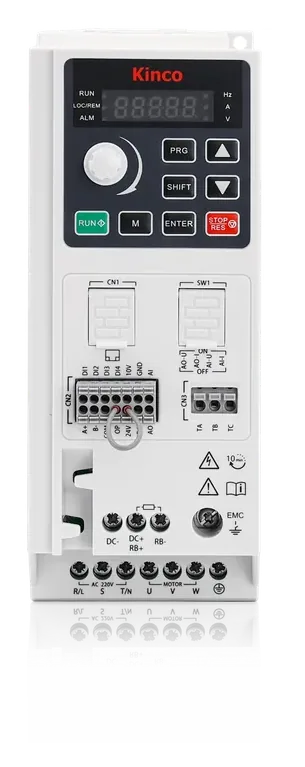
KC100-W1 — VFD purpose-built for pump applications

The KC100 is a universal, precision-type, high-performance vector frequency converter with a built-in constant pressure water supply PID algorithm. It is not a generic VFD with PID added on — it ships with a pump-tuned wizard that asks for only the pressure range, sensor type, and pump count, and configures the rest automatically.

Key features

  • High-performance AC motor vector control — handles weak / unstable grid conditions common in industrial sites
  • V/F + SVC control modes for stable water pressure under flow disturbance
  • Master–slave: 1 master + up to 5 slaves over RS-485, with auto-rotation
  • Slave promotion on master fault — system stays online
  • Auto sleep / wake at zero flow — eliminates wear on idle pumps
  • Timing function for scheduled tank fill / off-peak pumping
  • Native pairing with Kinco IoT HMI for cloud monitoring
  • 4 DI · 1 AI · 1 AO · 1 RO · 1 RS-485 · 0–50 kHz pulse output
View full KC100 datasheet & pricing →
Kinco
KC100-W1
3-phase 380 V · vector control · CPS PID
▌▌▌▌▌▌▌▌ ▌▌▌▌▌▌▌▌ ▌▌▌▌▌▌▌▌
CE UL STO PLd In stock
Field deployment

Case: Russian industrial water treatment — FDP-30 flotation unit retrofit

Customer

A 14-year-old Russian water-treatment specialist serving 150+ enterprises across the Russian Federation and CIS — including natural gas, oil, and railway companies.

Challenge

Replace the legacy FDP-series float-relay-contactor control on industrial water-treatment plants with a modern, compact, microprocessor-based system supporting both manual and automatic operation.

Solution

Kinco K506-24AR PLC + GL2070E2 7" Ethernet HMI, with custom control algorithms, mimic diagrams, and equipment schematics for the FDP-30 flotation unit.

What the system delivers

  • Manual mode for setup and commissioning — operators start/stop each flotation component individually
  • Auto mode with no operator intervention — sequenced startup at predefined fluid levels
  • Auto-redundancy — backup pump auto-starts after timer expires; primary pump stops; ensures even wear
  • Fault archive — interlocks and fault logging for downstream analysis
Brand migration

Replaces — Siemens, ABB, Schneider, Danfoss, Yaskawa, Mitsubishi

If your existing system is built on any of the drives or PLCs below, you can migrate drop-in to Kinco for a typical 30–50% hardware-cost reduction and 2–7 day lead times.

Siemens → Kinco KC100
SINAMICS V20 / G120 (pump variant)
ABB → Kinco KC100
ACS580 / ACQ580 water/wastewater
Schneider → Kinco KC100
Altivar ATV320 / ATV630 pump
Danfoss → Kinco KC100
VLT AQUA Drive FC 202
Yaskawa → Kinco KC100
GA500 / iQpump1000
Siemens → Kinco AK / K-series PLC
S7-1200 / S7-200 SMART (small pump station)
Mitsubishi → Kinco AK / K-series PLC
FX3U / FX5U
Siemens → Kinco GL2070E2 / MK070
KTP / SIMATIC HMI Basic 7"

Honest note: Kinco does not replace high-end multi-axis EtherCAT motion stacks (Siemens S7-1500 + S210 servo, Beckhoff TwinCAT). For pump, fan, and HVAC applications below 630 kW with PID, master–slave, or BMS integration, it is a direct functional substitute.

Technical specifications

Full system specifications

Control mode
PID (sensorless vector or V/F)
Pump topology
Master–slave (1 master + up to 5 slaves) or 1-to-1
Pump auto-rotation
Built-in (prevents bearing damage from idle pumps)
Pressure setpoint range
0.05–2.5 MPa (configurable)
Pressure feedback
4–20 mA / 0–10 V transducer input
Power range (per VFD)
0.75 kW – 630 kW
Input voltage
3-phase 380 V / 415 V / 440 V / 480 V (50/60 Hz)
I/O on KC100
4 DI · 1 AI · 1 AO · 1 RO · 1 RS-485 · pulse 0–50 kHz
Communication
Modbus RTU/TCP, optional CANopen, BACnet via gateway
Sleep / wake-up
Auto sleep on no-flow, auto wake on pressure drop
Fault diagnostics
Pump dry-run, over-pressure, sensor break, phase loss
Remote monitoring
Kinco IoT cloud (HMI 4G/Ethernet) — read pressure, energy, alarms
Enclosure (system cabinet)
IP54 standard, IP65 optional, ambient 0–45 °C
Certifications
CE · UL (KC100) · STO ISO 13849-1 PLd
Where it's used

Industry applications

Residential & high-rise

Booster pump sets for 8–40 floor buildings; replaces water towers and saves rooftop loading.

Hotels & hospitals

Stable shower / sterilization pressure across all floors with night-time auxiliary pump for low demand.

Industrial process water

Cooling tower make-up, boiler feed water, process rinsing — Russian water-treatment case (above).

Agricultural irrigation

Variable demand drip / sprinkler systems with sensor feedback and remote 4G monitoring.

Municipal pump stations

Booster stations for district water networks with SCADA integration over Modbus TCP.

HVAC chilled / hot water loops

Pairs with cooling towers and chillers — see /solutions/heat-exchange/ for the full HVAC stack.

FAQ

Frequently asked questions

The answers procurement, integrators, and engineers ask most often.

What is a constant pressure water supply system? +
A constant pressure water supply system uses a pressure transducer, PID-capable VFD, and PLC to keep pipe-network pressure stable regardless of how many taps are open. Pumps speed up or down to match demand, eliminating water towers and saving 20–50% energy versus fixed-speed pumping.
How many pumps can the Kinco KC100 control in master–slave mode? +
One KC100 acts as master and controls up to 5 additional KC100 slaves over RS-485 — a total of 6 pumps. Auto-rotation cycles which pump leads, equalising wear. If the master fails, a slave can take over without stopping the system.
Do I need a separate PLC, or can the VFD do it alone? +
The KC100 has built-in CPS PID and can run a small 1–2 pump system stand-alone. For 3+ pumps, BMS integration, sequence logic, scheduled tank fill, or remote monitoring, add a Kinco AK/K-series PLC. For one-cabinet IoT control, the MK series PLC+HMI all-in-one is the most compact option.
Can this replace my Siemens / ABB / Schneider pump system? +
Yes. The KC100 is functionally equivalent to SINAMICS V20 (pump), ABB ACQ580, Schneider ATV320 pump variant, and Danfoss VLT AQUA FC 202 for constant pressure applications. Wiring is similar (3-phase in, 3-phase out, 4–20 mA feedback, RS-485). Migration usually takes one shift per cabinet.
What is the typical lead time and where do you ship from? +
Most KC100, AK PLC, and GL HMI SKUs ship ex-stock from our Shenzhen warehouse in 2–7 business days by air freight (DHL / FedEx) or 25–35 days by sea. Air-freight a complete 4-pump BOM lands in 5–10 days door-to-door for most of EU, Middle East, and the Americas.
Does the system support remote monitoring and BMS integration? +
Yes. Kinco IoT HMIs (GL/MK series) connect to Kinco Cloud over 4G or Ethernet for remote pressure / flow / energy / alarm dashboards. For BMS integration, the system speaks Modbus TCP natively and adds BACnet/IP via a 3onedata gateway when needed.
How much energy can I expect to save vs a fixed-speed pump? +
Real deployments typically show 20–50% energy savings, depending on demand variability. Energy savings come from (1) running pumps only as fast as demand requires, (2) sleep mode at zero flow, and (3) eliminating throttling losses. Higher demand variability = bigger savings.
What should I check before specifying the system? +
Three things: (1) max flow rate and max pressure of your pipe network, (2) number and rated power of pumps, (3) whether BMS / SCADA integration is required. Send these to our sales engineers and we will return a complete BOM, wiring schematic, and price within 24 hours.

What Automation Liberty is — and isn't

We are
  • • An independent industrial automation supply & migration partner.
  • • A fast-shipping source of Kinco, Kemron, USR, 3onedata products.
  • • Your engineering counterpart for selection, BOM, and commissioning support.
We are not
  • • Not a Siemens / ABB / Schneider / Mitsubishi authorised distributor.
  • • Not affiliated with the OEMs whose part numbers appear on this page.
  • • Not a replacement for site-specific engineering review of your pump curve and pipe network.

Ready to spec your system?

Send us your pump count, kW rating, and target pressure. We'll return a full BOM, wiring schematic, and FOB Shenzhen quote within 24 hours.

Or call our engineering line: see /contact for regional numbers (US · EU · APAC).