Drive Integration
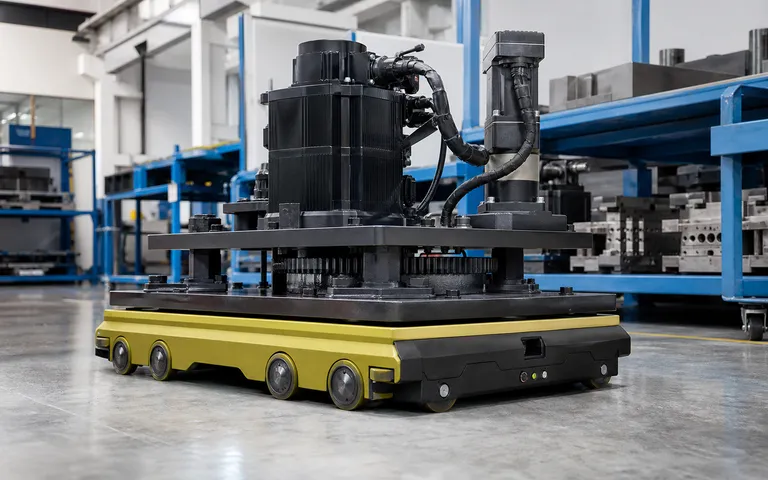
- Walking servo wheel with integrated drive, motor, reducer (iWMC family)
- CANopen DS402 or EtherCAT CoE communication
- Encoder feedback for closed-loop position and torque

Application solution · AGV / AMR
Quick answer
An AGV or AMR needs traction, steering or differential drive, optional lift or rotary axes, a controller, an operator interface and a defined safety boundary. The review matches Kinco iWMC drive wheels, iGMK modules and optional EdgeAccess2 remote operations to the vehicle duty.
AGV/AMR OEMs and integrators building compact 50 kg–2 t class mobile platforms and requiring model-specific review of drive wheels, lifting or rotary modules, and certification evidence.
Reference architecture · Model-specific review
Control problem
Four scoping blocks show the review path; they are not a wiring diagram.
Review the battery, BMS and charging interface together with loop fusing, emergency disconnect and the required STO boundary.
Select the iWMC walking-servo-wheel family from payload, speed, gradient, floor surface and chassis steering style.
Review iGMK rotary and lifting modules against chassis kinematics, jack-up and cargo-transfer duties.
Confirm CANopen DS402 or EtherCAT CoE, encoder feedback, embedded-HMI cabling and the optional EdgeAccess2 remote-operations scope.

Use this table to compare component roles, exact model names and key specifications before application review.
| Role | Component | Key spec |
|---|---|---|
| DRIVE | Kinco iWMC Walking Servo Wheel | Integrated drive+motor+reducer+wheel · selection by payload + speed + gradient |
| MODULE | Kinco iGMK Rotary Module | Chassis rotation · integrated reducer |
| MODULE | Kinco iGMK Lifting Module | Cargo transfer · integrated reducer |
| HMI | Kinco HMI (embedded) | Internal cable routing · diagnostic + status display |
| PLATFORM | Kinco EdgeAccess2 | Remote ops + OTA + alarm push |
| BRIDGE | USR CAN-to-Ethernet | Optional · for chassis-to-WMS integration |
Configuration summary. This motion stack covers 50KG–2T AGV/AMR solution configurations. The cited integrated-wheel layout uses 35% less installation space, while the iGMK lifting or rotary layout uses 30%+ less footprint than the compared split-component layouts.
This is a candidate architecture, not a quotation. BOM review checks each line against your machine, and programming support scopes the control work once the hardware is agreed.
The reviewed range covers 50KG–2T AGV/AMR configurations. Practical payload depends on the chosen iWMC model, torque, wheel diameter, gradient and duty cycle.
The cited integrated walking wheel uses about 35% less installation space, and the cited rotary or lifting module uses 30%+ less footprint than the compared split-component layouts. Results depend on the actual layout.
Certification scope varies by exact iWMC and module variant. Current CE/UL declarations and STO or functional-safety evidence must be verified in the named model's datasheet; component evidence does not certify the complete AGV/AMR.
Application review
Send the payload, duty, voltage, protocol, safety scope and any existing part numbers you already know.
Limits. These figures describe the stated configuration, not Automation Liberty customer results. This is a candidate architecture; exact model, compatibility, certification, availability and commercial scope are subject to engineering review and confirmed at RFQ.
Independent engineering and sourcing partner. Product names and trademarks are the property of their respective owners and are used for identification only.
Why no list price? Every quote follows an engineering review of your application — you get a validated price, not a catalog number.