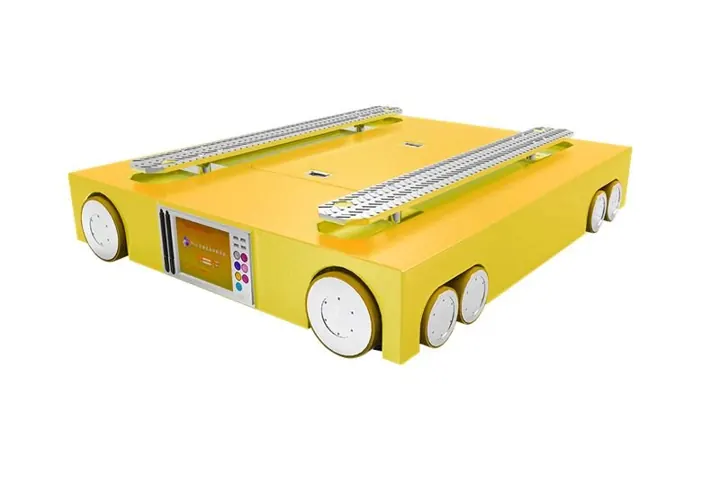
Tank Shuttle (50kg)
- Max travel speed 4 m/s, max acceleration 2 m/s²
- Travel positioning ±2mm, fork extension ±1mm
- 5-axis integrated servo configuration

Application solution · LOGISTICS
Quick answer
A warehouse shuttle needs travel and lift servos, position feedback, motion control, communications and a defined vehicle-safety boundary. The review matches Kinco iSMD or SMC motion hardware and AK840 control to payload, speed, acceleration, gearbox, positioning and WMS-interface needs.
Warehouse automation system integrators and 3PL operators deploying 4-way pallet shuttles, tank shuttles, air shuttles, spider vehicles, climbing robots, and servo conveyor lines.
Reference architecture · Model-specific review
Control problem
Four scoping blocks show the review path; they are not a wiring diagram.
Select the candidate travel and lifting families from the tank-shuttle, pallet-shuttle, air-shuttle, spider-vehicle or conveyor duty.
Review travel, jacking, fork-extension, direction-change and conveyor axes against the required payload and motion duty.
Confirm EtherCAT where multi-axis synchronization is required and review sortation-sensor connections to the available drive I/O.
Review integrated-servo cabling, shielding and grounding for the expected high-frequency start-stop duty.

Use this table to compare component roles, exact model names and key specifications before application review.
| Role | Component | Key spec |
|---|---|---|
| TANK-SHUTTLE | iSMD80-100-DQAK-AAK-000 | 50kg shuttle travel · 750W |
| TANK-SHUTTLE | iSMD80-040-DQAK-AAK-000 | 50kg shuttle traverse / widening · 400W |
| TANK-SHUTTLE | iSMD60-040-DQAK-AAK-000 | 50kg shuttle fork extension · 400W |
| TANK-SHUTTLE | iSMD80-075-DQAK-AAK-000 | 50kg shuttle direction change · 750W |
| 4-WAY-1.5T | SMC80S-0150-30AAK-5DSUFD145-AB-000 | 1.5T travel · 80-flange 1.5kW |
| 4-WAY-1.5T | SMC80S-0120-30SBK-5DSUFD145-AB-000 | 1.5T jacking · with brake |
| AIR-SHUTTLE | iSMD80-075-DQBK-CAK-000 × 4 | Air shuttle 30kg travel · 750W with brake |
| AIR-SHUTTLE | iSMD80-100-DQBK-CAK-000 × 2 | Air shuttle lifting · 1KW with brake |
| SPIDER | iSMD60-040-DQBK-EAK-000 × 4 | Spider vehicle travel · 400W |
| SPIDER | iSMD80-075-DQBK-EAK-000 × 4 | Spider vehicle winches · 750W |
| CONVEYOR | iSMK60-021-DMAK-AA-000-BSC × 2 | Conveying + jacking · 50kg pallet · available on request |
| FORK-SERVO | Tank Fork Toggle Servo | 24V · Modbus · 0.16/0.48Nm · 52×28×66mm |
| CTRL | Kinco AK840 | EtherCAT master · anti-shaking algorithm |
Configuration summary. The cited warehouse-shuttle configurations state ±2mm travel accuracy at 4 m/s, ±1mm fork-extension precision and up to 51% power savings versus an AC asynchronous-motor baseline.
This is a candidate architecture, not a quotation. an engineering BOM review checks each line against your machine, and PLC and HMI programming scopes the control work once the hardware is agreed.
The cited configuration states up to 51% power savings versus an AC asynchronous-motor baseline. Actual savings depend on duty cycle, payload and the motor scheme being replaced.
The published BOM is sized for standard EU/JP pallet platforms. Non-standard pallet sizes (1.2×1.2m, 1.5×1.5m heavy) require engineering review of motor torque, gearbox ratio, and chassis stress.
A third-party WMS can be evaluated through the vehicle controller, gateway and the WMS vendor's documented API. EtherCAT and CANopen may serve the motion layer, but they do not by themselves provide WMS integration. Recipe exchange, status mapping and exception handling remain subject to engineering review.
Application review
Send the payload, duty, voltage, protocol, safety scope and any existing part numbers you already know.
Limits. These figures describe the stated configuration, not Automation Liberty customer results. This is a candidate architecture; exact model, compatibility, certification, availability and commercial scope are subject to engineering review and confirmed at RFQ.
Independent engineering and sourcing partner. Product names and trademarks are the property of their respective owners and are used for identification only.
Why no list price? Every quote follows an engineering review of your application — you get a validated price, not a catalog number.